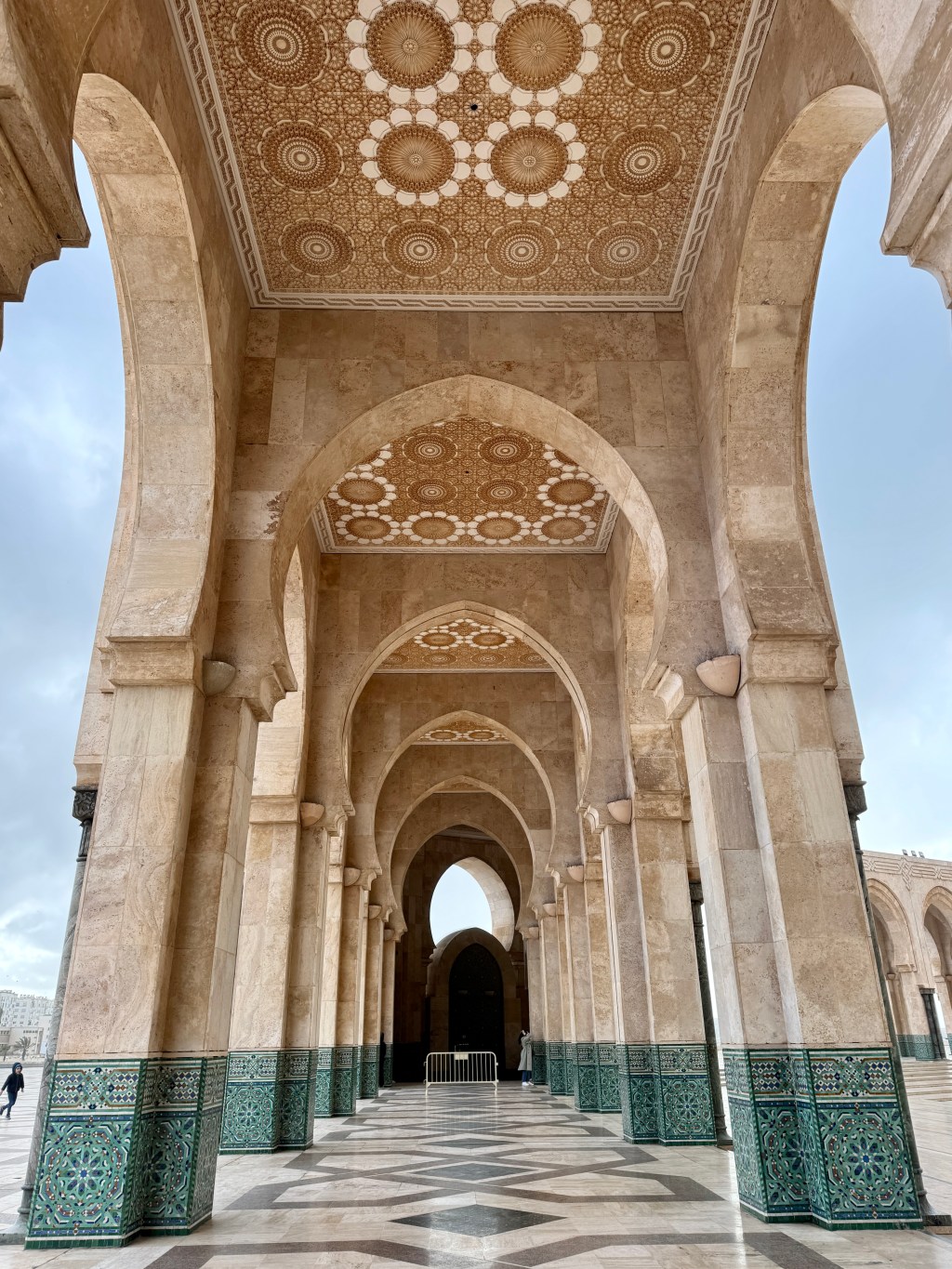

Not so secretly, Morocco is my favorite country I’ve traveled to so far.
The allure of a culture so different from where I’ve traveled before is what drew me in, and the incredible hospitality of Moroccans is what compelled me to come back.
On my fourth trip to Morocco, I spent a week in between the cities of Casablanca, Marrakech, and Essaouira during March, which is the Holy Month of Ramadan for Muslims (at least for 2025, the exact dates change every year since it is based upon the lunar calendar).
Table of Contents:
- Important vocab:
- What it’s like to travel to Morocco during Ramadan
- What celebrating Ramadan is like
- Why do people fast during Ramadan?
- Is it worth it to visit Morocco during Ramadan?
A bit of background on Islam:
Important vocab:
- Allah
The Arabic word for God
- Five Pillars of Islam
Practices that form the foundation for life as a Muslim.
They include: the declaration of faith (Shahada), prayer (Salah), almsgiving (Zakat), fasting during Ramadan (Sawm), and pilgrimage to Mecca (Hajj).
For more information: https://www.metmuseum.org/learn/educators/curriculum-resources/art-of-the-islamic-world/unit-one/the-five-pillars-of-islam
- Iftar
The fast-breaking, post-sunset meal once Maghrib, the sunset call to prayer, has been performed.
- Muhammad
The prophet and messenger of Islam
- Qur’an
The holy book of Islam which was revealed to Muhammad over the course of 23 years
- Sawm
The religious fast, abstaining from food and water (+ smoking and sexual relations) from sunrise to sunset, during the month of Ramadan
- Suhoor
The pre-dawn meal to prepare the body for the day of fasting during Ramadan
Morocco is a majority Muslim country, with Islam being the official religion of the state. An estimated 99% of the population practices Islam, according to the 2023 U.S. Department of State’s Report on International Religious Freedom.
Islam is the second-largest religion in the world, in terms of followers, and has been around since the year 610.
The monotheistic religion (believing in only one God) is based upon the teachings of the prophet Muhammad, who received revelations from God via the holy book known as the Qur’an.
One of the duties of followers of Islam, who are known as Muslims, is to follow the Five Pillars of Islam, as outlined in the Qur’an.
One of the Five Pillars of Islam is the month of religious fasting during Ramadan.
To learn more about Islam, check out this detailed, yet easy-to-understand guide from PBS: https://www.pbs.org/wgbh/pages/frontline/teach/muslims/beliefs.html
I had uncertainties about traveling to Morocco during Ramadan since I am not Muslim.
Would things be open during the day?
Would there be good restaurants still open?
Was it still worth it to visit Morocco during this time?
In this article, I will cover:
- What it’s like to travel to Morocco during Ramadan
- What celebrating Ramadan is like
- Is it worth it to visit Morocco during Ramadan?
What it’s like to travel to Morocco during Ramadan:
First and most importantly: no it is not a ghost town during the day and most businesses are still open.
Are there fewer restaurant options than at other times of the year? Yes.
Are there still restaurant options? Also yes.
The amount of restaurants open during the day varied from city to city.
For example, in touristy cities such as Marrakech and Essaouira, most restaurants were open and running as normal during the day.

In less touristy cities such as Casablanca, fewer restaurants and cafes were open, but food vendors could still be found, such as juice and bread stands.
It is safe to say that you do NOT have to stock up on food the night before if you want to eat during the day.
Honestly, coming from a bread lover, the main thing I cared about was if I could buy fresh msemen (Moroccan crepes) during the day.
I’m a tad bit obsessed with msemen.

I was quite pleased that there were indeed still vendors selling fresh msemen during the day.

Which makes sense.
Moroccans need to do their shopping for their iftar meal (the meal that Muslims eat after sunset during Ramadan to break their fast) before sunset.
So during the day, markets and grocery stores functioned as normal, where I observed people shopping and bargaining for their iftar and suhoor (the pre-dawn meal).

The only thing I missed out on because of Ramadan hours was visiting the palaces in Marrakech, but that was mostly because I only had one day.
If I had stayed one more day, I would have gotten to visit.
Other than that, traveling in Morocco during Ramadan wasn’t that different from other times of the year I’ve visited.
What celebrating Ramadan is like:
Observing Ramadan is a wonderful thing.
At sunset’s call to prayer, there is a brief flurry of commotion where Moroccans head home, or temporarily close their shops, and prepare iftar, their evening meal.

Our iftar meal (essentials include dates and harira soup)
It is heartwarming to see the love and community that Ramadan promotes in facilitating shared activities amongst Muslims, such as the same meal and prayer times.
Partaking in Ramadan is an even more wonderful experience.
I had the honor to celebrate part of Ramadan with my friend and her family, who all practice Islam.
At 4:45 am, we woke before sunrise to have suhoor.
Because I never eat this early, my body wasn’t hungry at all during this time (especially after eating so much at iftar).
Despite my lack of appetite, I ate heartily because I knew that I would not be eating again until sunset.
After suhoor, my friend and her family prayed and then we all went back to sleep.

I learned that the suhoor greatly decreased my appetite to get me through the day.
It wasn’t until the last remaining 2-3 hours that I started really craving food again.
The day that I fasted without water was the most physically challenging.
I felt like a zombie. My brain was foggy, and my body just wanted to sleep.
Why do people fast during Ramadan you ask?
The purposes of the sawm (the Ramadan fast) are the following:
- to promote self-discipline from worldly pleasures
- teach empathy and compassion for those less economically privileged and have no choice but to go without food and/or water
- increase connection to Allah (the Arabic word for God)
To be transparent, I only went 1 day without food and water (which is a true sawm), and 2 more days without food from sunrise to sunset.
But I decided to not eat during the day out of respect for my friend and her family since I was staying with them.
And because I am not Muslim, I did not participate in the prayers 5 times a day – though my friend did invite me to join her at the mosque one night.
Overall, the experience gave me a profound sense of respect for Muslims who do it for the entire month – it really is an admiral testament to their faith and devotion.
Is it worth it to visit Morocco during Ramadan?
If you haven’t already guessed, my answer is yes!
It is a unique and beautiful time to visit and learn about this sacred time for many Moroccans.
Traveling is about growing cultural awareness and appreciation, after all.
Ramadan, then, is the perfect time to visit Morocco.
As always, educate yourself the best you can beforehand, and explore with open-mindedness and respect.

So what do you think? Did I convince you to go to Morocco during Ramadan? Maybe even try it for yourself?
Have you ever been to Morocco or another Muslim country during Ramadan?
Let me know in the comments!
For more on Morocco, check out:
- Solo Female Travel 101
- Morocco: A Photo Travel Diary
- Podcast episode about things to know before traveling to Morocco: https://open.spotify.com/show/0sKg59FKrEIK8P042cm0wa?si=xWomLUIMSOOABPyzxvNg1w
 gottacaseofwanderlust
Leave a comment